As Missouri lawmakers consider new regulations on large-scale solar development, farmers across the state say the issue is less about energy policy and more about economic survival.
Legislation under discussion would either temporarily halt new solar projects or impose additional requirements on future developments, including local approval, acreage limits, and changes to tax policy. Supporters say the proposals would allow the state to establish clearer rules. Opponents warn they could disrupt projects already underway and create uncertainty for rural landowners.
The debate comes as Missouri seeks to attract data centers, manufacturers, and other large power users that require significant new electricity generation. Solar energy has emerged as one of the fastest and least expensive ways to add capacity to the grid, and industry advocates argue that slowing development could put the state at a competitive disadvantage.
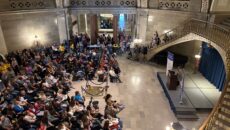
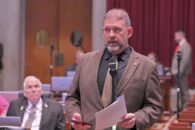
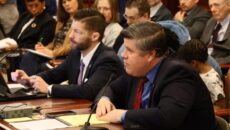
At a recent Senate Commerce Committee hearing, testimony reflected the divide. Supporters of new regulations cited concerns about construction impacts, local control, and the pace of development. Others, including farmers, developers, and rural officials, said solar projects are already providing financial stability in areas where traditional agriculture has become increasingly uncertain.

For Callaway County farmer Fred Atkinson, the debate reflects a reality he has been navigating for decades.
Atkinson is a fifth-generation farmer whose family has been in Missouri since 1827. After earning a degree in agronomy from the University of Missouri and serving in the Air Force, he spent years acquiring and restoring farmland that had been heavily eroded.
“I cleared the land, built terraces and waterways, fertilized it, put in irrigation, everything I could do to bring it back,” Atkinson said.
Through conservation practices, he reduced soil loss and rebuilt productivity on land that had been worn down over generations.
“When we farmed it, we were always losing at least three tons of soil every year,” he said. “Before conservation, it was as high as twelve tons. Three tons is about what the soil can regenerate.”
Despite those improvements, Atkinson said the economics of farming have become increasingly difficult to sustain.
“I really love farming. I wish I could keep on farming, but we’re not making any money,” he said. “We’re just spinning our wheels.”
Like many farmers, he faces rising input costs and fluctuating commodity prices that leave little room for profit.
“This year we’ll spend around $900 an acre growing a crop, and if we do $1,000, we’ll be really happy,” Atkinson said. “That’s no return on $15,000-an-acre land.”

After reviewing a proposal to lease land for solar development, Atkinson said he approached the decision cautiously, studying both the economics and the long-term impact on his land.
“They produce as much as $10,000 an acre worth of electricity, maybe more,” he said. “If you’re going to get $10,000 an acre versus maybe making $1,000, why wouldn’t you?”
For Atkinson, the decision ultimately came down to stability, something he said is increasingly rare in agriculture.
“It’s a retirement program,” he said. “It’s an estate for them to live on, and my grandkids should never have to worry.”
Supporters of solar development say leasing land for projects has become a way for farmers to generate steady, predictable income while maintaining ownership of their property. In many cases, they said, that income helps families hold onto land that might otherwise be sold during difficult years.
Solar projects also provide consistent tax revenue for rural counties, which can be used to fund schools, infrastructure, and emergency services without increasing the tax burden on residents.
Atkinson also pushed back on concerns that solar development harms farmland or the environment.
“With the solar panels, that deeper grass is keeping the soil,” he said. “It’s an ideal environment for microorganisms, earthworms, birds, everything ought to proliferate really well.”
He said some of the claims about environmental damage are exaggerated.
“They’re just making up stuff, I guarantee you,” Atkinson said. “And a lot of the loudest critics don’t even live near it, they have no idea what’s going on here.”

Still, the legislative proposals have raised concerns among farmers and developers about how far regulations could go.
A statewide moratorium could halt projects already in development, while additional requirements such as acreage limits or increased taxes could make future projects financially unworkable, they said. Others warned that shifting policy could discourage long-term investment in Missouri at a time when neighboring states are competing for energy projects.
Missouri is also one of a minority of states without a comprehensive regulatory framework for large-scale solar development. Some lawmakers have said new standards are needed, but industry advocates argue those standards can be implemented without pausing projects already underway.
No action has been taken on the proposals, leaving uncertainty for both developers and landowners.
For many farmers like Fred, this issue goes beyond just energy production, but instead is about whether he and many other Missourians should have the right to do with their land what they want, and how they can keep their farms in their family.
Jake Kroesen is a Jackson County native and a graduate of the University of Central Missouri. He holds a B.S. in Political Science.