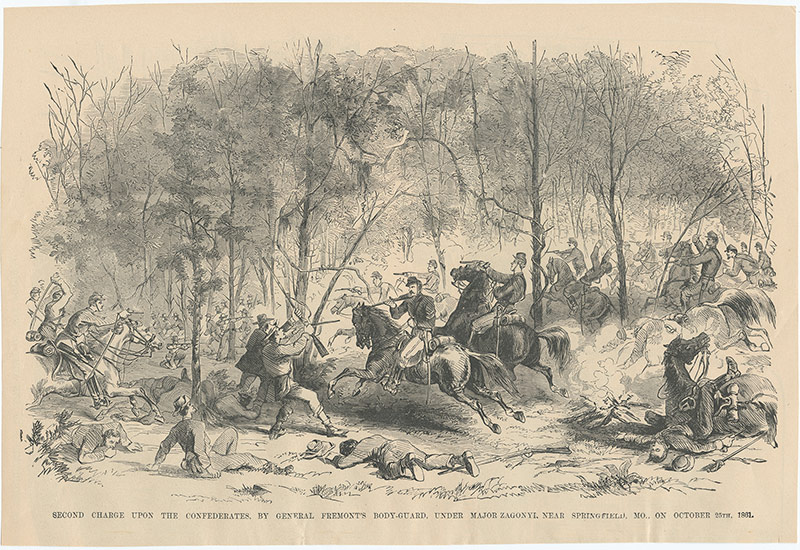
In the context of the Civil War, Missouri is important, not because of famous battles that shaped the War’s outcome (there were none), but because of its position as a border state. There were four—Kentucky, Missouri, Maryland, and Delaware—and later five, as West Virginia separated from Virginia in 1863. All of them were slave states, possessing economic and political connections with both the Union and Confederacy. Missouri, it can be argued, was the most politically divided. Violence had been endemic, as guerrilla warfare emerged as a conspicuous feature and would only metastasize as the war dragged on, reaching a high point in 1864.
While soldiers bore the brunt of war, civilians had their lives upended, leading to great social and economic hardship. In the early stages of this great contest, many Americans had, according to historian James McPherson, a “romantic, glamorous idea” of war. Those feelings, doubtless to say, quickly evaporated. R.C. Arnett, a resident of Missouri, witnessed the encounter at Fredericktown. “I will never forget the awakenings and the horrors of war,” he confided in his diary. “Everything ransacked and demolished, garnered wheat destroyed, stock of all descriptions taken or killed and left on the ground, smoke-house gutted, and fences all burnt.” Arnett, who was twelve years old at the time, provided great detail of the morning leading up to the battle: “Monday morning (October 21, 1861) was a nice, cool, frosty, crisp morning, and everybody was up listening at the federal troops crossing the bridge over the river west of town…I wended my way up East Main Street to the court house and looked down S. Main Street and saw the soldiers lying on the sidewalks asleep with their guns stacked in bunches all along and some riding about through the town, I completely forgot my business, as I was so interested in the uniforms, guns, horses, drums, horns, etc.”
The wartime separation of husband and wife was a common occurrence. Lizzie E. Brannock, whose husband, a Confederate soldier, had been imprisoned in St. Louis by the Union Army, lamented to her brother in a letter, penned in 1864, describing the conditions of war: “Thus far you have survived in this most horrible reign of terror…our country is desolate, indeed almost entirely a wilderness, robbery was an everyday affair so long as their was anything to take, our farms are all burned up, fences gone.”
By focusing, not so much on experiences of soldiers or their commanders, but on the experiences of ordinary Missourians during wartime, we can better understand other pertinent dimensions of the Civil War with enhanced clarity. For example, how were individual families impacted, whose crops and personal belongings were often plundered by soldiers and guerrillas? How did ordinary Missourians interpret the war? How did they handle the difficult emotions that beset them? What did they see from a day-to-day perspective, as the war, in some instances, unfolded in close range? These important questions drive my analysis. By drawing on a range of letters, diaries, and other personal writings, this article explores the fundamental carnage, suffering, fears, and uncertainty wrought upon by war from a civilian point of view, in Missouri, from 1861 to 1865.
The Economic Experience
When shots rang out at Fort Sumter on April 12, 1861, the state of Missouri, already rocked by political violence and social instability going back to Stephen A. Douglass’ disastrous principle of Popular Sovereignty, the cornerstone of the infamous Kansas-Nebraska Act of 1854, allowing for citizens to decide on slavery’s fate in those territories, waited with anticipation on further developments. When the Fort was surrendered by out-numbered Union forces the following day, seven states had already left the Union: South Carolina, Mississippi, Florida, Alabama, Georgia, Louisiana and Texas. Missouri Governor, Claiborne Fox Jackson, a Democrat and vociferous Lincoln critic, who favored secession, merely exacerbated Missouri’s tenuous position within the Union, when, on April 16, he rebuffed Lincoln’s call for 4,000 Missouri troops, declaring the President’s actions as “illegal” and “unconstitutional.”
Three weeks earlier, on March 19, a Missouri delegation, dominated by pro-Union individuals, voted overwhelmingly, 98-1, not to leave the Union. “The Convention pronounces that there is at present no adequate motive for Missouri to secede,” reported the Hannibal Daily Messenger, and “the conclusions of the Convention are nearly unanimous. No sufficient motives for leaving the Union now.”
Jackson’s tenure as governor, one of the shortest in Missouri history (six months), ended unceremoniously when he, along with pro-Confederate elements, sought to devise a plan whereby Confederate forces would seize the U.S. Arsenal in St. Louis—the largest arsenal in the slave states. On May 10, 1861, Union forces, led by Captain Nathaniel Lyons, suppressed the governor’s plot, igniting a riot in St. Louis, culminating in the death of 28 people.”
In September 1861, during the Battle of Lexington, Isaac McGirk experienced the economic consequences of the Civil War in close proximity. In a letter to his mother-in-law, McGirk, a Missouri farmer, described the chilling scenario: “I went over to Mr. Bolly to see him about moving our families out of the way and whilst at his house the Federals from town came out and cut me off from leaving no one with May or the children. They got into a hot skirmish in my corn and hemp fields which lasted until ten o’clock in the day which time I got one of the soldiers to take me home.” Although McGirk’s property had “not been disturbed,” Federal troops, by contrast, “burned Sami Wilson’s house, Mr. Roberts, Tome Wallace’s and Tom Alfords Flemings and Mr. Hunters,” while also setting fire to “the covered bridge between my house and Mr. Timricks.” McGirk, moreover, informed his mother that “the Col’s house is destroyed even the rails and tree fencing of every kind bushes and shrubs nothing left that would hide a chicken.” Wistfully, McGirk noted that, despite the economic destruction unleashed “upon American soil by American citizens,” the restoration of “peace” and “harmony” can be procured “among our people.” As historian Edward Ayers notes in The Thin Light of Freedom, that “armies rushed over landscapes like rank floods, leveling forests and devastating fields, stripping food and livestock, washing away in an hour the work of generations…armies changed everything and everyone they touched.”
The logistics of armies, as well as the unpredictability of war, set the stage for direct contact between armies and civilians. These interactions invoked a complicated mix of fears, resistance, support and desperation. The latter more so for armies—both Union and Confederate—who often suffered from limited rations and supplies. The foraging of homes and crops, by soldiers, occurred frequently as they marched long distances by wagon and foot. “The Confederates came into Otterville Friday night,” Pauline Stratton jotted in her diary, “and burned the bridge. Came into Syracuse Saturday night robbed the town Clothes Shoes Boots Bridles and horses.”
By 1862, slavery in Missouri began to deteriorate rapidly, resulting in the collapse of its slave-based economy. “Negroes are now in a transition state and are not what they once were,” a woman from Fayette wrote to her husband. The war itself, from the very beginning, inspired slaves to not only flee the plantation but to flock to Union lines. After Antietam, Lincoln, well aware of the criticism he would receive, issued the Preliminary Proclamation on September 22, giving the states in rebellion 100 days to re-enter the Union. Once the rebel states rejected the President’s proposal, Lincoln issued the Emancipation Proclamation on January 1, 1863. The document, providing the Union the vehicle to transform slaves into soldiers, marked a turning point, as it fundamentally altered the character of the war and served as a prelude to the Thirteenth Amendment. The Proclamation however did not apply to the 800,000 slaves in the border states or Tennessee, which was, at that point of the war, primarily under Union control. Missouri, according to the 1860 Census, had 114,931 slaves within its borders. Despite Missouri’s exclusion from the Proclamation, the President indeed faced criticism from newspapers, questioning its legality: “Our readers know” purported the Daily Missouri Republican, “that we do not believe in the doctrine that “military necessity” authorizes the President, or anyone else, to decree a legal status by proclamation.” Other Missouri newspapers, like the Missouri State Times, for example, published an article declaring the President’s actions “unwarranted” and a “gigantic usurpation.”
For ordinary Missourians raised in a slave society, revolutionary societal changes ushered in by the war, even before Lincoln’s Proclamation, offered a harbinger for not only Missouri but for America. The Proclamation “will make not much difference with the slave,” John Forbes of Shelbyville predicted in a letter to his sister living in New York, “slavery is being killed by the war and the changes brought about by the war.” Forbes’ description of slavery’s fate encapsulated the emotions of many. Because of the war, a Missouri man wrote, “slavery is doomed in this state; I feel as if we had better lost all of our negroes than suffered as we have already.”
The fact was, slavery served as foundational to the South’s economy for two centuries. The end of slavery, as many southerners understood it, was the unthinkable calamity. Since the Revolution, white southerners spoke from wide-ranging perspectives along a continuum that ran from rebuking the institution, to declaring it beneficial to the slave, a force for good, underscoring the paternalistic argument that figured prominently through the nineteenth century.
For Priscilla Thomas Ingram Patton, a resident of Springfield and a Confederate sympathizer, whose husband left home to ensure his safety, offered different perspectives in her extensive diary. On the one hand, she echoed a paternalistic view that, under this ideology, the slave is “good, quiet, obedient, and industrious, and seemed to take such a great interest in all belongings to the place.” On the other hand, she wrote, “I am convinced that it is a sin to keep them in slavery” and desires to “free them and move away from them.” Those words are revealing in that white southerners did not possess a monolithic view of paternalism for validating slavery. Some in fact justified the practice by pointing to the Bible, while others did not.
While slavery’s downfall hampered agricultural production, the war concurrently weakened commerce, farmland, infrastructure as well as communities. Banks, that had thrived before the war, failed; especially those controlled by pro-confederate bankers and businessmen. “Times is hard hear thare is no buisness of an kind a going on heare now evry thing is high and very scarce,” Camilla Kensinger of western Missouri wrote to her father in June 1862. “The country is full of theaves and they are doing a great deal of mischief.” Elsewhere, Bruce Colman, a farmer from Moniteau, who grew cereal grains for sale in Jefferson City, described, in short, the economic conditions immediately after the Battle of Wilson’s Creek to his children on August 20, 1861: “No market for nothing; no money.”
Like farmers, Missouri colleges also faced wide-ranging anxieties. William Van Doren, a professor at Westminster College in Fulton, chose to take a teaching job in California due to shrinking enrollment. “The civil disturbances in the state drew off several of our young men,” and has sadly “reduced the number of students from 170 to about 85,” Van Doren wrote in his diary. Indeed, both the Union and Confederacy not only enacted draft laws but also engaged in the practice of forced enlistment through intimidation and coercion. “The rebels has ben stoping the boats on the Mo R and stealing everything on board that was of any value to them,” A.J. McRoberts of Saline, wrote to his wife in August 1862. Even more, “there is a considerable danger of being pressed into service,” McRoberts explained, “they are takeing evry man subject to militery duty and the late order of the secratery of war makes us liable to be arrested at any time and compelled to perform militery duty unless we enrole ourselves in the Malitia, so I don’t see any chance to escape.”
The war, meanwhile, caused significant disruptions to both big and small businesses. From Lincoln’s blockade, to high inflation, to the seizure and destruction of railroads, business owners of many types, primarily in the south, found themselves fraught with considerable challenges and difficulties. Even more, some business owners, like James and Elizabeth Thompson, who owned a general store in Clay County, Missouri, and sold various items to Confederate soldiers, were forced to take an oath of allegiance to the Union, which they did in August 1862. Although Elizabeth’s letter to her husband, dated March 11, 1864, fails to mention the wars economic impact on their store, it does however shed light on the economic destruction of property in Clay County: “A large potio of your fencing was burned. One third of the west string and nearly all the rails between Wills farm and yours and all except three pannals from Wills fence to the big gate was burned.”
The Social/Emotional Experience
In May 1861, two months preceding what is widely accepted as the first battle of the Civil War—Bull Run—Nancy Chapman Jones, living in Boonville, Missouri, penned a letter to her daughter describing the state of affairs: “This is the Fourth of May, just two months since Lincoln’s inaugural, and in what a deplorable condition is our great country, once so prosperous, united and happy, now in a state of anarchy, confusion and run, and when, where and how, it will end God alone knows.”
On August 10, 1861, just outside of Springfield, the Confederacy captured a victory in what would be known as The Battle of Wilson’s Creek. The triumph was important, solidifying Confederate control in southwestern Missouri. “Federal loss 800 Killed!” reported the Hannibal Daily Messenger. “Severe cannonading was kept up for two hours,” spreading “slaughter and dismay in the ranks of the enemy pursuing them to their camp,”
Mrs. J.J. Bruton, who was six-year-old Lavonia Ray at the time of the battle, was riding her horse with two friends when, suddenly, a man appeared on horseback demanding she and her friends to “get out of here; they’ll be fighting like hell in less than 10 minutes!” The daughter of the postmaster of Wilson Creek, Bruton, in 1934 remembered her parent’s strikingly different reaction to the looming dangers of war. Her mother, more circumspect of the two, was “greatly alarmed…she knew the Confederate troops were encamped in a valley a short distance from our farm.” Bruton described seeing “a black line moving in the distance, and as we watched it, we recognized it as an army of marching men.” After observing the soldiers, “mother got all the children lined up, both white and black and hustled them together with grownups into the cellar.” Bruton recalled that her father, undauntedly, watched the battle from his front porch “with bullets striking all about him and bombs bursting in the yard,” never leaving this position “until firing ceased.”
Thomas Westlake, who was also a child during the war years, remembered looking down the common road connecting Columbia and Fayette, and observing Federal troops advancing towards his home. “The Sight very much frightened our party, on the first impulse we all took to our heels with all the speed we were capable of all started up one direction but Soon Separated.” Hiding in bushes to sidestep soldiers, Thomas’ father was caught and ordered to surrender at gunpoint. My father, Thomas recalled, “rose up and requested them not shoot an unarmed man.” Thomas was also ordered to halt, but refused. The soldiers thereby opened fire “with the whiz of about a half dozen Minnie Balls over my head from their muskets.” Thomas got away unharmed. The soldiers eventually “returned to the house with father only a prisoner as a reward for the chase. They soon devoured our cider and breakfast and on questioning father found that we wer not the gang they wer looking for.”
By April 1862, there were 51 regiments of soldiers in the field, and nearly 10,000 more Union soldiers in the state, who were “eager to assist in freeing Missouri from rebellion,” The St. Joseph Herald reported on April 6, 1862. “Union men are in a majority here, and they can reciprocate any movements of a guerrilla character which the secessionists may institute.” The Macon Gazette also illuminated the growing threat of guerrillas by raising the question of whether the war, in Missouri, would degenerate into one of “brigandage and partisan ferocity.” On June 22, 1861, in an effort to address predatory warfare, the Enrolled Missouri Militia was established. This part-time force, created by Unionists, aimed to “put down robbery, plunder, and guerrilla warfare” which it is, “plainly the duty and interest of every citizen to aid in doing,” declared the Columbia Herald—Statesman.
In terms of guerrillas, inflicting terror in primarily rural areas enabled them to not only evade capture but to perpetuate a campaign of raids, plundering, beatings, and murder. Civilians, sympathetic to the North, as well as Union soldiers, were targeted. “The Bushwhackers are murdering and nabbing a great many people,” Robert Wells, a Missouri resident, wrote in a letter, “mostly noncombatants, and a good number of these catch it every few days.”
For guerrillas, it wasn’t about winning battles. Rather, it was about winning the war of attrition. Some Confederate sympathizers balked at the tactics used by Guerrillas, though, many endorsed them, based on indignation towards Federals, who they believed were genuine “enemies of the country” and “the murderers of the brave defenders of our down-trodden State.” Bushwhacking, a form of guerrilla warfare, was perpetrated by both pro-Union and pro-Confederate camps, although more so by the latter. But, by 1862, as Union sympathizers seized control of Confederate banks, leading to foreclosure of properties and financial instability for many Confederate families, coupled with other factors pertaining to the war, “politics and ideology became less important, and revenge came to the fore,” Historian James Erwin argues in his book, Guerrillas in Civil War Missouri.
Guerrilla membership, meanwhile, varied. Many of its members had joined the Missouri State Militia in 1861. Some joined to protect themselves and their families from northern aggression, while others, who came from wealthy slave-owning families, fought to maintain the social order. And, there were those who joined, simply, for the excitement of plundering, revenge and murder. Historian Allen Guelzo, a leading expert on Civil War studies, draws a historical line “connecting the activities of Civil War guerrillas with the postwar insurgency of the Ku Klux Klan.”
As noted above, regular and irregular troops, from both sides, committed atrocities by employing guerrilla tactics in Civil War Missouri. For civilians, being seen assisting the enemy could result in death. Garrett Robinson, a resident of Fayette, was seen taking supplies to refugees and, according to Bessie Pritchett, was subsequently “hung by federal troops” as they “left him for dead.” Robinson however avoided death, as the “limb broke and he fell,” Bessie wrote to her husband, explaining the horrific event.
As the war dragged on, the hostilities amplified. It was not the Union gaining the strategic advantage alone—far from it—that had exacerbated the hostilities between Union and Confederate partisans in Missouri. Rather, it was the “cruel and unfeeling” treatment by Union soldiers, as Priscilla Thomas Ingram Patton saw it, along with a series of measures enforced by the Union Army on Confederate civilians to not just establish control in the state, but to neutralize the growing problem of guerrilla warfare carried out by pro-Confederate groups. One measure in particular, General Order No. 11—the forced evacuation of all residents from four separate Missouri counties to curtail guerrilla activity—was imposed on August 25, 1863, four days after the horrific slaughter in Lawrence, Kansas, whereby a band of pro-Confederate guerrillas, led by William Quantrill, murdered 180 unarmed men and boys, and set fire to 100 buildings, in what historian Joseph Beilein argues was “the worst atrocity of the Civil War.”
Under Quantrill’s leadership, coupled with his role in the Lawrence Massacre, William Anderson, known to history as “Bloody Bill” Anderson, emerged as the most feared guerrilla leader in Missouri. Possessing a prodigious appetite for violence and lawlessness, Anderson, who came from a pro-slavery family in Kansas, although he was likely born in Kentucky, relished the opportunity of leading a band of outlaws against Union soldiers and their civilian allies who, he believed, was responsible for killing his father as well as the death of his sister.
Not long after Lawrence, a falling out occurred between Anderson and Quantrill, paving the way for Anderson to form his own band of murderous guerrillas. With plans to form a calvary to combat the atrocities launched by Anderson and his crew, W.J. Dunn, a Union soldier, explained the horrifying state of affairs: “The gorillas are just murdering the sitizens just like Hogs before the slaughter pen.”
In late September 1864, a train carrying over 120 passengers and twenty-three Union soldiers, who were going home after serving under William Sherman in the Capture of Atlanta, were passing through Centralia, Missouri. In the distance the conductor saw what appeared to be a large group of men, around 80 in total, all dressed in blue uniforms. Thinking it was Union soldiers, he stopped the train. Anderson’s men, who had stolen the uniforms, immediately swarmed the train, robbed the passengers of their belongings, and ordered the unarmed soldiers off the train, and to remove their clothing. Standing in a line wearing only their underwear, the soldiers were subsequently shot in the head, in close proximity.
Anderson and his guerrillas, fresh off the barbarous Centralia Massacre—the darkest episode in all of Civil War Missouri—mobilized his men, as they made their way to several towns including, Boonville, Fayette, and Glasgow to loot and kill. Already having witnessed the savagery of war just months earlier, in which Garrett Robinson was left hanging from a limb to die by Federal soldiers, Bessie Pritchett, in a letter to her husband, dated October 22, 1864, described the arrival of Anderson’s men to Fayette. “On Tuesday night the bank was robbed some of Price’s and Andersons men they however were entirely courteous to us—searched or rather pretended to search for arms, but they looked in very few things—and told us they wanted
nothing we had only ‘arms and state funds,” Bessie explained. “They got about $30,000 out of the bank besides some silver plate and Grandma Johnsons gold goblet Aunt and I begged for it—but one replied very cooly, ‘he had worked too hard to get it’ and ‘twas of no use to ask him not to take it.’
Anderson and his men, Bessie noted, had been drinking whiskey as they “robbed Grunabaums store.” On Friday, Anderson “came to town with nearly 50 men to burn the E.H. and college, but were kept from it by a secesh women. They however burned the federal camp.” Next, Anderson and his band traveled to Glasgow, where they targeted Ben Lewis, one of the wealthiest men in the city, “beat and cuffed” him, and “were only kept from killing him by Mrs. Thompson and by paying them $5000 nearly all in gold.” After Glasgow, on October 26, 1864, Anderson was shot and killed by Union forces.
Confederate Bushwhackers, despite Anderson’s death, continued their assault of cruelty and destruction. Nancy Winfrey, from Carroll County, along with her younger brothers, were left shaken after discovering their “old papey ling at the side of the road and his hole head shot off,” Nancy wrote to Caroline and James Kirkpatrick in a letter dated November 27, 1864. In May 1865, one month after not only the Fall of Richmond but also the surrender of Lee’s army at Appomattox—the symbolic end to the Civil War—not to mention, Lincoln’s assassination at Ford’s Theatre, the Confederate Bushwhackers struck again, this time in Kingsville, located in Johnson County. A note, written by an unknown author, describes in explicit detail an account of what happened on May 7, 1865. According to the document, the guerrillas, led by at least one member who had served alongside Bill Anderson, “swept down on the quiet village and commenced firing on the citizens and burning the Unionist homes and places of business.” After a short time, “the bushwhackers soon had possession of the town which they left mostly in ashes after robbing the families of money and clothing and killing the men and boys.” The author also provided names of those who were murdered: “James Paul, Welter Burris, Will Duncan, L.C. Duncan, Sam Duncan, Abner Ryan, ‘Illiam Johnson, David Givens and some laborers.” Two of the victims, William Duncan and Welter Burris, were “only 14 years old. They were shot” and “buried in a double grave.”
Conclusion
From 1861 to 1865, the evidence shows that ordinary Missourians—farmers, professors, business owners, husbands, wives, little boys and little girls—not only experienced Civil War Missouri in different ways but also that those experiences were overwhelmingly negative. Many experienced economic hardship. Others experienced personal, social, and emotional hardship, and even murder. There were those like J.J. Burton’s father, who watched the Battle of Wilson’s Creek from his porch as bullets whizzed by his head. There were those like, Thomas Westlake who, as a child, refused to halt and was consequently shot at by Federal soldiers. There were those like, Isaac McGirk, who watched in disbelief, as soldiers destroyed property and set fire to his neighbor’s homes. There were those like, Nancy Winfrey who, along with her two brothers, stumbled upon the body of their father who was murdered in cold blood by Confederate Bushwhackers. And, there were those like 14-year-old William Duncan and Welter Burris, whose lives ended before they even started, as they were shot and buried in a double grave by guerrillas.
As terrible as the Civil War was, with an estimated death toll between 700,000—750,000, more than twice as many as Antietam, War of 1812, Mexican-American War and the Spanish-American War combined, as James McPherson points out, it did nevertheless produce a number of consequential changes, chief among them, eradicating America’s greatest sin, slavery, and in doing so, ushering in a new birth of freedom for African Americans. Meanwhile, Missouri also experienced profound change, not just from a population standpoint, which rose from 1.1 million in 1860 to 3.1 million by 1900, but from an economic standpoint, as agriculture, along with railroads and industry took center stage. But for ordinary Missourians, who were enveloped in civil war, and did not have the advantage of hindsight, nor a blueprint to go by, the level of fear and uncertainty they felt from a day-to-day perspective is difficult for contemporary Americans to fully comprehend. Perhaps, R.C. Arnett of Fredericktown said it best when reflecting on his experience: “I will never forget the awakenings and the horrors of war. Most especially the Civil War.”
Corey Daleski is an Instructor of History at Three Rivers College in Popular Buff.
Discover more from The Missouri Times
Subscribe to get the latest posts sent to your email.