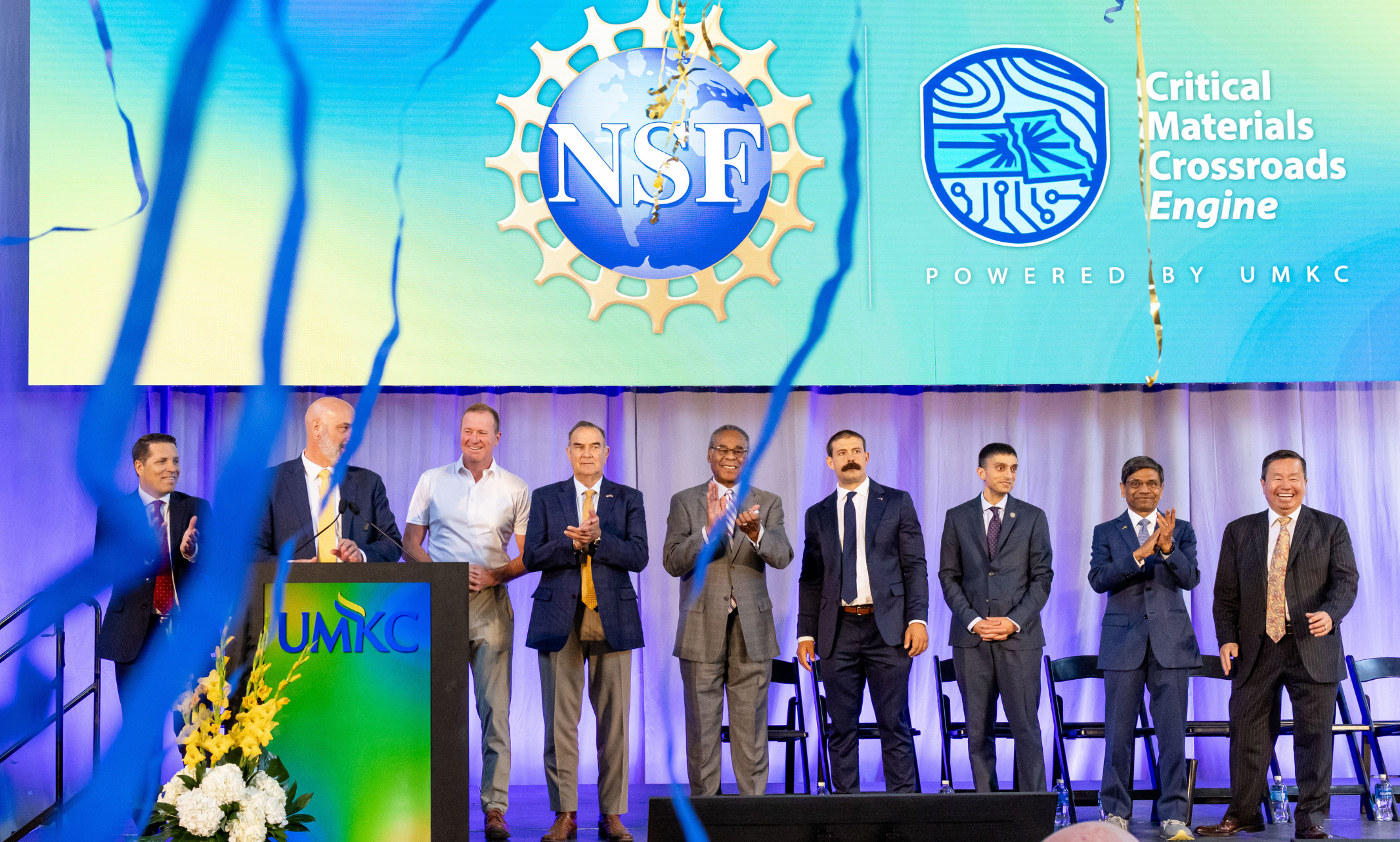
The University of Missouri-Kansas City is leading a new effort to make the Kansas City region a national center for critical materials research, production and manufacturing, backed by a National Science Foundation award of up to $160 million.
Missouri and Kansas political, business and university leaders gathered Friday at Union Station to launch the NSF Critical Materials Crossroads Engine. The initiative will connect universities, companies, government agencies and workforce organizations to strengthen domestic supply chains for minerals used in technology, manufacturing, energy and national defense.
The push comes as the U.S. looks to reduce its reliance on foreign sources for critical minerals. The COVID-19 pandemic exposed weaknesses in global supply chains, while China’s control of much of the world’s mineral processing has raised concerns about the country’s influence over materials needed for everything from semiconductors to weapons systems.
“Missouri and Kansas recognized an opportunity before us, and we chose to compete for the future together,” Gov. Mike Kehoe said. “That’s good for our region, and it’s great for our country.”
Kehoe was joined by U.S. Sen. Eric Schmitt, U.S. Rep. Emanuel Cleaver, U.S. Rep. Sharice Davids and leaders from the NSF, universities and private industry.
The project will focus on materials including cobalt, nickel, copper, lithium, graphite, gallium and rare earth elements. These minerals are used in batteries, communications equipment, advanced manufacturing, aerospace and defense.

“The $160 million investment that’s going to be made right here is part of a broader effort to bring these supply chains home,” Schmitt said. “We simply cannot rely on China for all the critical materials we need, from everything from iPhones to the materials we need to build fighter jets.”
Missouri already has some of the pieces needed to play a larger role in the industry.
A 2024 Missouri Geological Survey study estimated the state could have as much as 150,000 metric tonnes of cobalt, along with an estimated 103 million pounds of nickel. If the cobalt deposits can be developed economically, they could represent one of the larger domestic sources of the mineral.
Missouri also has a long mining history. The Southeast Missouri Lead District has produced lead, zinc and copper for generations, and researchers are now looking at whether the region’s geology could support production of other materials.
Missouri S&T has become a major part of that work. The university was designated a U.S. Tech Hub for Critical Minerals Innovation in 2024, with research focused on extraction, recycling and workforce development.
The new Kansas City initiative adds another piece by bringing research, manufacturing and investment together across the two states.
More than 260 organizations and leaders are supporting the Critical Materials Crossroads Engine. Missouri participants include the Department of Higher Education and Workforce Development, Department of Natural Resources and Missouri Geological Survey, as well as Burns & McDonnell, Black & Veatch and the Greater Kansas City Chamber of Commerce.
The project is expected to generate as much as $40 billion in economic output, support about 10,000 jobs and attract more than $3 billion in public and private investment over the next decade.
The award is also the largest grant ever received by UMKC and the University of Missouri System.
UMKC officials point to Kansas City’s central location and transportation network as advantages, along with the region’s existing engineering, manufacturing and research base.
The initiative comes as Missouri also considers how state policy can encourage more investment in critical minerals.
A bill which passed in the 2026 Session known as the Missouri Defense and Energy Independence Act (HB 1834) would created tax credits and grants for companies producing strategic materials such as cobalt, nickel and rare earths for defense and energy projects.
Private investment is already underway. U.S. Strategic Metals has invested more than $265 million in southeast Missouri and expects to produce alloy-grade cobalt for defense and aerospace applications.
The state’s mining potential also comes with challenges. Developing a new mine can take years, and Missouri’s history of lead mining has left environmental problems that continue to affect communities in the region. New projects will face questions about permitting, reclamation and local impacts.
University of Missouri Board of Curators Chairman Todd Graves said the project shows what can happen when government, universities and businesses work together.
“This significant investment positions Missouri to lead in an area that is vital to our nation’s future while creating lasting opportunities for our universities, citizens and economy,” Graves said.
The launch at Union Station was also a reminder of the region’s history of cooperation. The building was restored after Missouri and Kansas voters approved a bistate tax in 1996.
“Today, we embark on our region’s next great endeavor,” UMKC Chancellor Mauli Agrawal said.
Regional business and civic leaders also announced a new leadership group that will work with UMKC and other partners to recruit companies and build out the critical materials industry.
“We have the talent. We have the research capacity. We have the industry. We have the universities,” Agrawal said. “And, most importantly, we have partners on both sides of the state line.”
For Missouri, the opportunity is broader than the Kansas City project itself. The state has mineral resources, an established mining industry and universities already working on critical materials. The new investment gives those efforts a larger regional and national platform.

Jake Kroesen serves as the Editor of the Missouri Times. He hails from Independence, Missouri and enjoys all things Jackson County. A graduate of UCM, he obtained his degree in Political Science.
Discover more from The Missouri Times
Subscribe to get the latest posts sent to your email.