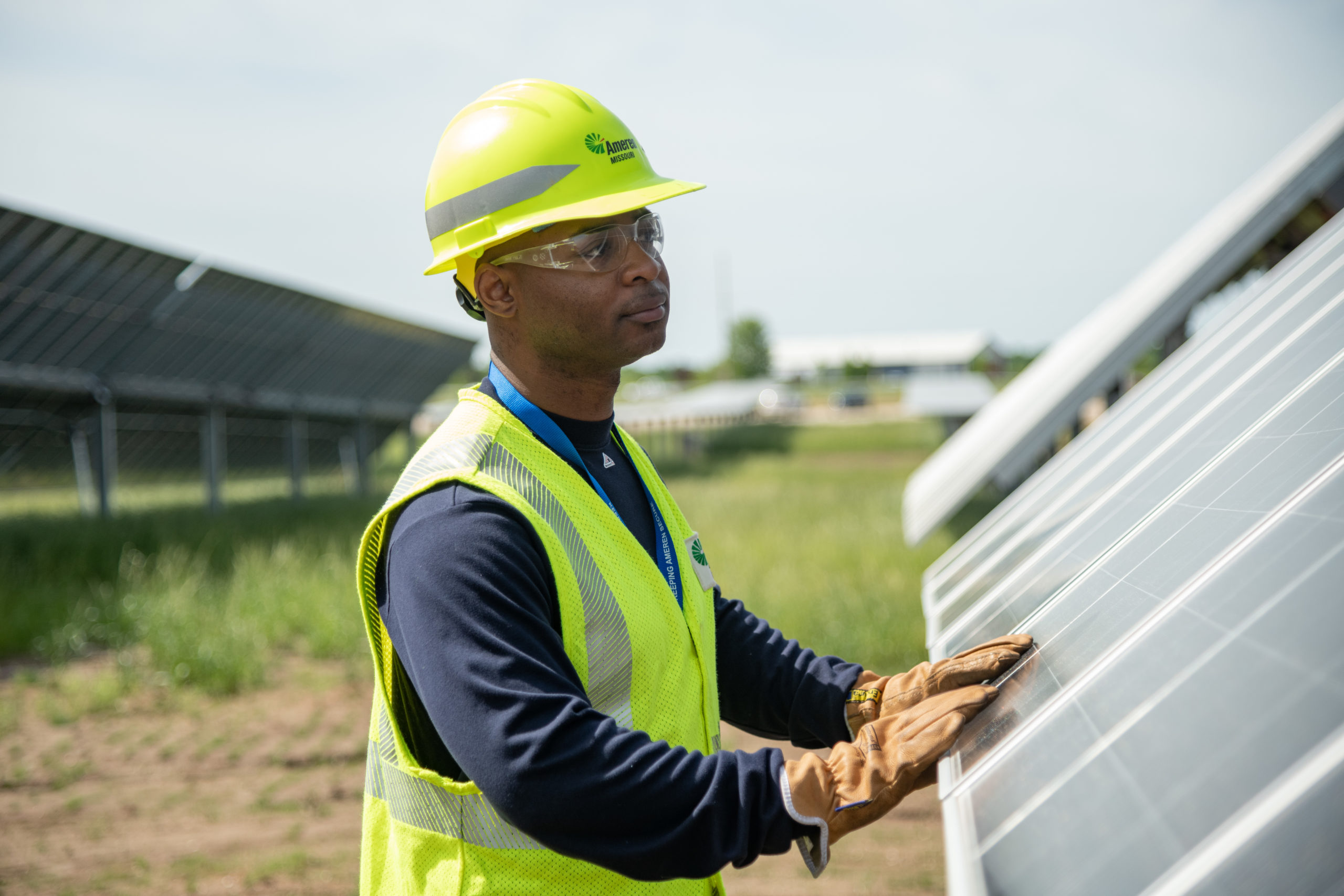
As Missouri seeks to attract data centers, manufacturers, and other large power users, lawmakers are weighing whether to pause large-scale solar development, one of the fastest and least expensive ways to add new electricity to the state’s grid.
Farmers, developers, and rural officials warned during a Senate Commerce Committee hearing last Tuesday that halting solar projects could undermine property rights, destabilize rural economies, and send a signal that Missouri is closed for business at a time when demand for power is growing. Supporters stressed the issue is not about pitting energy technologies against one another, but whether the state can meet rising electricity needs while remaining competitive with neighboring states.
During the lengthy hearing, testimony largely focused on whether proposed legislation would stall an industry that supporters say is helping keep family farms intact and providing dependable revenue for rural counties. The bills under discussion would either halt new solar construction statewide through 2027 or impose new restrictions and taxes on future projects.
Supporters of solar energy repeatedly framed the industry as a financial backstop for farmers facing volatile commodity prices, rising input costs, and shrinking margins. Several testified that leasing portions of their land, often acreage that is less productive for crops, allows them to weather bad years and avoid selling off family land.
“Solar helps hedge against bad years,” said Dane Reed of Vernon County, who leased land to a solar developer. “It’s the most profitable crop we have right now.”
Once constructed, witnesses said, solar projects provide counties with predictable, long-term revenue streams that allow local governments to budget with confidence, an uncommon level of certainty in rural finance. Supporters argued that those revenues help fund schools, roads, and emergency services without raising taxes on residents, while also diversifying rural economies traditionally tied to agriculture alone.
Several speakers emphasized that solar development does not eliminate farming altogether. In many cases, grazing and other agricultural uses continue alongside solar installations, and land can be returned to production after a project’s lifespan ends.
Critics of the proposed moratorium said it would override landowners’ rights and retroactively penalize those who entered contracts in good faith.
“If I have 1,000 acres of land, why should you be able to stop me from putting solar panels on it?” asked Sen. Karla May during the hearing.
Opponents of solar development raised concerns about construction impacts and quality of life. Laura Stinson told senators her parents’ Callaway County property has been affected by noise, dust, and glare from a nearby project.
But not every Callaway County resident has had the same experience. Paul Beuselinck, who lives near the solar farm, said, “While there’s certainly more traffic on County Road 225, I’ve found the workers on the project to be very courteous and easy to work with.”
Beuselinck also pointed to environmental benefits, adding, “I understand why some locals are upset, but the project is fairly quiet, and it has also created roughly 2,000 acres of wildlife refuge and can provide many birds, small mammals, and bees shelter.”
Two bills sponsored by Senate President Pro Tem Cindy O’Laughlin and Sen. Sandy Crawford would halt all commercial-scale solar construction and direct the Department of Natural Resources to develop statewide regulations governing solar facilities. The pause would remain in effect until rules are finalized or Dec. 31, 2027, whichever comes later.
O’Laughlin said the moratorium is intended to give communities more visibility into projects before development begins. Supporters of solar countered that the proposal would freeze development while granting DNR broad rulemaking authority in a state that has yet to adopt baseline standards.
A separate bill sponsored by Sen. Travis Fitzwater would allow existing projects to continue but impose new requirements on future developments, including county commission approval, caps on solar acreage, and the elimination of tax exemptions for solar equipment.
Even some witnesses who supported regulation said Fitzwater’s bill remains overly restrictive and risks shifting the goal posts for farmers and developers who have relied on existing law. They warned that uncertainty created by shifting policy could deter long-term investment in rural Missouri.
Several noted that nearly every form of energy production receives tax incentives, while solar, now widely regarded as the cheapest source of new energy, faces the expiration of most federal tax credits beginning in 2026. Witnesses argued that layering new state taxes and restrictions on top of expiring incentives could place Missouri at a competitive disadvantage compared to neighboring states.
Kurt Schaefer, director of the Department of Natural Resources, said Missouri is among a minority of states without a regulatory framework for large-scale solar projects. Thirty-six states currently regulate commercial solar development, he said, and Missouri could adopt standards addressing construction, operation, and decommissioning without halting projects already underway.
Developers warned that pausing solar development would effectively shut down the industry in Missouri and send investment elsewhere, cutting off a growing source of rural income.
“Reasonable guardrails make sense,” said Mark Walter, a consultant for solar developers. “But a moratorium is far too drastic, and it hurts landowners just as much as companies.”
No action was taken on the bills Tuesday, leaving Missouri’s solar industry, and the rural communities increasingly tied to it, waiting to see whether lawmakers move toward regulation that allows projects to continue or policies that bring development to a halt.
Jake Kroesen is a Jackson County native and a graduate of the University of Central Missouri. He holds a B.S. in Political Science.