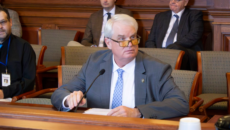
The Missouri House debated legislation this week establishing a statewide framework for autonomous vehicles, a proposal supporters say would help Missouri compete with neighboring states and prepare for the future of technology.
House Bill 2069, sponsored by Rep. Brandon Phelps, R-Warrensburg, would establish rules allowing autonomous vehicles to operate on Missouri roads while requiring companies to meet federal safety standards and comply with state traffic laws. It would also establish requirements for insurance coverage and procedures for interaction with law enforcement.
Supporters say the proposal is designed to provide clarity for companies developing autonomous vehicle technology while ensuring safety standards are in place before widespread deployment occurs.
Rep. Phelps said the measure addresses several issues at once as transportation technology continues to evolve.
“This is a safety bill, a technology bill and an economic development bill,” Phelps said. “It creates clear rules so autonomous vehicles can operate safely on Missouri roads while making sure Missouri is prepared for the next generation of transportation.”
Autonomous vehicles use sensors, cameras, and artificial intelligence systems to navigate roads without direct human control. The technology is already being deployed in several major American cities through driverless ride-hailing services and delivery fleets.
Across major cities in the US including, Phoenix, Austin, Atlanta, Miami, and Los Angeles, autonomous ride-hailing services are already providing transportation to hundreds of thousands of riders each week through fully driverless vehicles. If the legislation is approved, autonomous vehicles could be rolled out within the next year starting in St. Louis.
Safety framework
The legislation would establish statewide standards governing the testing and operation of autonomous vehicles in Missouri.
Companies operating autonomous vehicles would be required to ensure the vehicles comply with federal motor vehicle safety standards and are capable of operating in accordance with Missouri traffic laws. The bill also includes provisions addressing insurance coverage and communication with law enforcement in the event of a crash or traffic stop.
Early performance data from autonomous vehicle deployments suggests the technology may improve road safety. According to publicly reported safety data from Waymo over 127 million miles of passenger operations its driverless vehicles have experienced 91 percent fewer serious injury or worse crashes, 92 percent fewer pedestrian crashes with injuries, and 81 percent fewer injury-causing crashes compared with human-driven vehicles operating in similar conditions.
Supporters say the framework is intended to create consistent rules across the state rather than leaving individual cities or local governments to determine their own policies.
Regional competition
Across the United States, 40 states have already enacted laws allowing autonomous vehicle testing or deployment on public roads. All of Missouri’s neighboring states, apart from Illinois, have already adopted frameworks allowing autonomous vehicles to operate, leaving Missouri among the few states in the region without a comprehensive statewide policy.
Supporters say the legislation is also about ensuring Missouri remains competitive with other states that are actively attracting transportation technology investment.
The debate also comes as Missouri policymakers consider broader strategies for improving the state’s economic competitiveness. State leaders have recently discussed policies aimed at competing with fast growing states such as Texas, Florida, and Tennessee, which already allow autonomous vehicle operations. Industry analysts say autonomous vehicle technology is expected to expand gradually over the next decade as companies refine the systems and regulators establish safety standards.
The industry is also expected to generate significant economic activity. Analysts estimate the autonomous vehicle workforce could conservatively reach roughly 114,000 workers nationwide over the next 15 years in areas such as vehicle manufacturing, software development, distribution, and maintenance.
Manufacturing and servicing the vehicles is expected to create a wide range of jobs. Studies suggest that for every 1,000 autonomous vehicles produced, approximately 190 workers are required across development, production, distribution, and vehicle maintenance. Many of those positions include skilled technical roles such as engineers and software developers as well as manufacturing workers, technicians, and vehicle maintenance specialists.
Looking ahead
Over time, the technology could expand into additional uses outside of ride-hailing services. Supporters of the legislation contend that establishing a clear regulatory structure now will allow Missouri to prepare for future challenges and expansion of the industry while maintaining oversight of safety and operations.
House debate is expected to focus on the safety standards included in the bill and how the state should prepare for the long-term impact of autonomous vehicle technology on transportation and economic development. House leaders could bring up a vote on the legislation before lawmakers leave Jefferson City for spring break.